Turkey's only Nobel laureate, author Orhan Pamuk, has stated that the understanding of laicism held by Mustafa Kemal Atatürk, the founder of the Republic of Turkey, was very different from that of the military today.
Speaking to the Russian periodical Timeout Moscow ahead of a visit to the Russian capital planned for Aug. 27, Pamuk shared his opinion on various issues in Turkey. In an interview published under the headline “I am trying to explain Turkey to Turks,” Pamuk emphasized that his main target is the Turkish audience and not foreigners.
Read the whole story on Today's Zamam
Showing posts with label religion. Show all posts
Showing posts with label religion. Show all posts
Wednesday, August 26, 2009


Friday, October 10, 2008
Turkey's poisoned pens
Here is a very interesting and very comprehensive article about the Frankfurt Book Fair.
Full story on Nomadics
Turkey is this year's guest country at the Frankfurt Book Fair. For months now, the country's writers and critics have been embroiled in a bitter feud over the politics of participation. By Constanze Letsch
The 60th Frankfurt Book Fair opens in just a few days time, a moment that has been eagerly awaited in Turkey, this year's guest country, for almost two years. The Turkish government set aside a budget of seven million euros, and rented 4.260 m² of exhibition space. The country will be represented by 100 publishers, 350 authors, translators and academics, 320 artists, 10 literary and licensing agency representatives, 110 curators, presenters and coordinators and 120 media representatives: almost 1000 people in total.
1000 minus 20. Since July, a bitter feud has been bubbling away in the Turkish media over a controversial boycott of the Book Fair, in which to date, 20 of the invited authors and literary critics are participating.
Full story on Nomadics
Wednesday, October 01, 2008
Fulya Atacan: “The military say the State should not use religion, but they did it first"
(Published also on GroundReport)
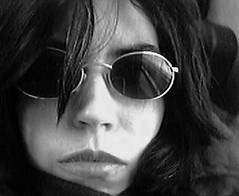
Black, long hair and an open smile that often turns ironic. I meet Fulya Atacan on a hot summer day, at the beginning of August, in the Cihangir branch of the famous Kaktüs Café. The music is quite loud, and her voice is not, but my dictaphone luckily succeeds in recording it without too much back noise.
Black, long hair and an open smile that often turns ironic. I meet Fulya Atacan on a hot summer day, at the beginning of August, in the Cihangir branch of the famous Kaktüs Café. The music is quite loud, and her voice is not, but my dictaphone luckily succeeds in recording it without too much back noise.
Fulya Atacan is Professor at the Department of Social Science and International Relations at Yildiz Technical University. I have contacted her because I was told she is “an expert of Islam”. She denies it, and explains: “I have worked with Islamic groups since the end of the 1980s. I did my PhD about one of the Sufi orders in Istanbul and then I worked with one of the radical Islamic groups in Germany. I also worked with a Sufi order, the Nakshibendi order in the Eastern part of Anatolia. I studied Political Science and then I did my PhD on Sociology, so I studied social sciences through different sources, but I'm not an expert of Islam”.
She's evidently expert enough, and she has that peculiar social insight I just need. I'm surely not interested in the theological aspects of Islam. She isn't either, anyway.
How do you interpret what's happening now in Turkey?
I'm sure that Turkey is a more secular State compared to 20 years ago. If you see secularism as a kind of process in which the effect of religion is decreasing in respect to economics, in respect to social life, in respect to science, it's true that Turkey is more secular than 20 years ago. But – you know – secularism means also changes of the main components of society. Turkey was a kind of agricultural society at the beginning of the 20th century. And only less than 20 percent of the population were living in big cities. Today 30 percent of the population is living in the agricultural area and 70 percent of the population is living in the big cities. This means that people are earning their lives not from agriculture but from industry, services, and so on. So this main change in society has also an effect on religion. Of course we cannot expect to see religion to remain unchanged. It has also changed. But we are witnessing today that religion is earning a new place in a new society.
So we are trying to get used to this new situation, and that's why some people are very upset to see how religion is getting organized. But it's normal. You know, if society is getting “evolved”, let's say, well organised, religion also will get its organization: associations, political parties... now we have all these things, and that's why people are getting a bit anxious about this change. But I don't think this change is making society more religious.
In the past they claimed that the human being cannot be represented. That's why we don't have the art of painting in Islamic society, and that's why there was a big debate at the beginning of the 20th century. But today even the most religious Muslim has no trouble with taking pictures. It's out of question now.
Letting women have secular education, or even religious education, was unthinkable at the beginning of the century. Today all religious women want to have better education in science, engineering, arts. And nobody discusses that.
So in that sense Turkey is more secular than at the beginning of the 20th century. But it's a new kind of existence of religion, so we are trying to get used to it, that's why it will take some time.
The issue of AKP is a little different question, because AKP is a political party. Yes, it's based on Islamic groups, no doubt about that; yes, it comes from Islamic tradition, no doubt about that; and many people are very religious in the party. But it's also a very modern organization. They want to stay in power, so they don't discuss certain issues which would be totally against the existence of the Turkish republic. AKP never thinks of changing the political system. Nobody in Turkey thinks that AKP would dissolve the parliament. Do we have this kind of fear? No. We know that AKP is a political party, it's acting according to the rules of the Turkish Republic...
Some people think they have a second-hidden agenda...
They are in power. Since 2002. So, that makes six years. No doubt that they are religious. They have faith in Islam, they want to see more conservative ways of life. But any conservative party in Turkey tries to do that. These are more conservative than them, but it doesn't mean they want to change the system, or that they want to run the country according to sharia. Because they have also changed. You know who was Recep Tayyip Erdogan? He came from a rural background, and moved to Istanbul, close to Taksim, he grew up there. He went to a religious school, and then he graduated and he became part of this political movement. Now, what about his sons and daughters? They got their education in Turkey first, and then they went to the United States. They got secular education, not religious education... I mean, they had religious education, and then they went to United States, do you expect them to become really fundamentalists like Bin Laden? They are becoming part of the ruling elite, although they have some problems. In two or three generations they will definitely be part of it, so what do you expect of him? To go against this system? To be part of – let's say – Saudi Arabia? Unthinkable. OK, some secular people do not like their style, but what don't they like? Their headscarves. They are religious images. OK, you may not like it, but it doesn't necessarily mean that these people are trying to establish a sharia State in Turkey.
On the other hand, right now in parliament, except for Kurds, in a way or another they are all conservatives...
I agree. That's why I think there is no need really to blame this party to try to establish a sharia State in Turkey. But behind all these discussions it's clear that there is a kind of tension and conflict between this conservative or religious ruling elite and the old establishment. You know, the army always considered itself as a kind of guardian of the Republican values. That's history. And the army establishment has big doubts about AKP. They believe that they are so religious that they are trying to undermine the secular State. And AKP failed to develop good relationships with the army.
On the other hand they have some problems with big industrialists. You know, these industrialists are very powerful, and they supported AKP, because these industrialists want to be part of the European Union, because they want to be part of the global market, so they believe this is the best situation for Turkey, so they supported AKP as long as AKP followed these rules, but it doesn't mean that they like AKP. Because these two “friends” or these two segments of society do not have many things in common. They did not go to the same schools, they did not get the same type of education, they did not grow up in the same environment. They are different. And the AKP government is mainly based on medium-size and small-size company owners, who support AKP. And these entrepreneurs see the European Union as a kind of way ahead of their economic improvement. They also support AKP. These new aggressive entrepreneurs want to be part of an elite. So AKP is representing more than Islam.
It seems in Turkey more and more women are wearing the Muslim headscarf. How do you interpret this tendency? Is it more religious or more political?
Maybe we should look at two different levels. The first level is very closely related with social change. As I said before, people in the agricultural, rural areas arrived in the big cities after the 1960s, then they maintained here things like covering their heads. But the people of the second generation did not like this traditional headscarf, because it shows your rural background. A new style of covering your head shows you belong to the city. So people are not very religious. They want to cover their heads, but they don't prefer this old style, which shows your rural background. They preferred headscarves, that we call türban. So in that sense it has nothing to do with religion.
On the second level, the political one, particularly after the 1980s, in universities some young female students intentionally decided to wear headscarves as a declaration of their identity. They said they were religious, they were Islamists and they wanted to use headscarves as a symbol of their identity. That's understandable. I mean, identity politics has its kind of symbols. We had some female students but the number was small. In the '90s the Islamic movement, as a political movement, becomes important and the number of the female students has grown. And today there are some female students who say: this is my identity, so I will cover my head and I must have the right to get into public places with my headscarf. That's understandable as well. Because it's partly political, because it's identity politics, but partly it's because of social change.
Actually we have now about the same number of covered female people as – say – 20 years ago. But they were not in Taksim, that's why we didn't see them. They were living in the slums. Then they got better education, they grew up in social life, so they don't want to go back, they want to sit in the cafés in Beyoğlu. We believed that this had something to do with slums and we never thought that a covered woman could sit in a café like this, so when we saw a covered woman in a place like this we were surprised. But, you know, they earn the same money as we do, they want to enjoy life as we do, but they prefer a kind of Islamic lifestyle.
What frightens people most seems to be just the fact that the headscarf is used as a symbol.
If we talk about identity politics you cannot ignore symbols. Let's look at the Kurdish movement: don't they have symbols? Of course they have. Because it's also a kind of personal identity, to show other people that I am Kurdish. This is exactly the same. I am religious, but it doesn't necessarily mean that this identity politics will create a deadly conflict.
Things are changing every day. We didn't have this kind of discussions – let's say – in the 1960s or 80s, but in 2000 we have different discussions. Nobody imagined we would have an Islamic party in power in Turkey. Since 2002 we have one. Do we have a big trouble with that? No. Okay, some segments of society have a big trouble with this government, like any governments. But mostly, no. We know that if there is an election, if there is a good opposition, then they will lose the elections. So it was unimaginable 15 years ago, it is imaginable and it is not a big deal now. In the coming years we will see what will happen. But I don't think that Turkey will become more sharia-based.
Another aspect of the problem is that many people in the West see the headscarf as a sign of oppression.
Not necessarily. In one respect it's true. You know, if you grow up in a very religious family, you don't have a right to choose. You grow up with headscarves, and that's your way of living. So, as long as you don't have a right to choose, it is oppression. But on the other hand, there are some religious women with headscarves, they use their headscarf as a kind of way out. You know, they go out of the house because they have Islamic duties to do, they are out of the house for eight hours a day, they are writing on Islamic newspapers, they are organising women non governmental organisations, they develop their skills in politics... So they also use the headscarf or the Islamic identity as a kind of means to emancipate from traditional female roles. It happens in the same quarter, let's say. On the one hand people are using the headscarf because they don't have another choice, but on the other hand some people use headscarves to become part of the public field, to try to find their way out of home, to be professional, to develop their political skills, to be political leaders... So, I cannot say that the headscarf is necessarily oppressive. In some cases, it is, but not always.
So, nothing is black and white, it's more complicated than it seems.
Islam has also been used as a tool in order to excite nationalist feelings...
That's true. I think that's the main problem. Particularly after 1980 and the coup d'etat, military governments saw that Turkey was divided and was heading towards a communist system, so it was better to keep society consolidated using religion as a kind of glue. Of course Islam has always been used by politicians, but for the first time they officially adopted a kind of State ideology called Turkish-Islamic Synthesis. They believed that Islam could be used as a kind of glue in this divided society, and Islam is also against communism. But this Islam had to be in the framework of the Turkish nation, they institutionalised it. They used it as a State ideology. Of course, it was established by the military. And there have been politicians - Motherland Party, True Path Party... - who also supported this ideology.
They believe that Kurdish separatism and Islamic fundamentalism are the main threats against the Turkish republic. So, what does it mean, once again? The military has stated that Islam should not be used by the State, but it's not easy to change it in a minute, and now nobody has a right to be surprised that AKP is using Islam in a nationalist framework.
You know, 90 percent of the population is being raised in it, because they changed the rules in primary and secondary schools after the 1980 military coup d'etat, and they taught this young generation the Turkish ideology called Turkish-Islamic Synthesis: we are good Muslims, but we are Turks, they made nationalism kind of supported by religion. So what do you expect? And nobody is trying to change it. No, of course there are some who are trying to change it, but they are a minority. That's the main problem, I believe. More important than AKP.
Now with the European Union secularists are really happy with that, they say “You cannot teach religion at school”, and the Islamists and the more conservatives say “Yes, let's make it optional”. But the problem is that it's the military government that made religious education compulsory in primary and secondary schools after 1980. Before that, it was optional in Turkey. And now nobody wants to change it. And the Erdoğan government once said that this will be compulsory but it will talk of history of religious faiths, and then another course, which is optional, will talk about Islam. And I think it's crazy, because nobody is teaching history of faiths on earth in these classes. They'll teach Islam, no doubt about that. So we will have not one, but two courses!
Actually they do not want to change this compulsory course. You know, Alevis went to the European Court of Human Rights saying that the State make them learn Sunni Islam. They are completely right. So they are against it, they don't want their children to attend these courses. And of course, they won the case, so they'll have to change the system. But nobody's doing anything.
During my education this course was optional. The State had to provide you with that course, but it was optional. And I had no trouble to say “No, I do not want it”. And after 1980 it has become compulsory. But who's going now to blame for that AKP? They did it. That's the problem, that's why we have this problem. We didn't have it 50 years ago. But now we have it.
So can we say that Turkey is a secular country? Even if religion is used by the State?
It is. I mean, if we look at the history of Italy, you know how religion is used. If you consider secularism as a kind of change in the main orientation of society, it is secular. In the political round it's a different case. You know it has begun to be used as a tool in politics. But this tool is not the base of politics. It's just a tool. The military government definitely didn't define itself as Islamist. There is no intention, it was one of the tools that can be used, so is it against secularism? It is politics. Of course it makes society more conservative. Of course they were successful in curbing the power of the leftist groups, no doubt about that. But it was a tool. They did not envision a kind of more sharia-based State.
Even for tolerant people, there are disturbing aspects in some Muslim practices, such as women separated from men during the prayer...
Of course. You know, that's a big problem. If you are a very committed Muslim, you accept certain rules in Islam which make you a second-class citizen, no doubt about that. And it's the problem these Islamist women are facing now: they realize that they have education, they have better skills than men, they can be part of this society, so they do not have to accept the authority of men, and they have started questioning Islamic tradition in respect to women's position in society, in family, all these things. Of course this is not a kind of mass movement, but it's clear that it's a process, and many Islamist women won't say openly they are feminists, because you know, feminism is a kind of “bad word”. But in private they will say: I must admit that feminists have a good point in that.
All these women have to question, this is the most important process. We might have a kind of liberation theology or feminist theology in Islam, but it's in the process. It has just started, we don't know, it might be developed, they're questioning the traditional role of women in classical Islamic writings, and in that tradition it's a big step for these women, and it's reality now. You can find some Islamist female writers: they won't accept any male authority! They are very self-confident, they know what they want, they want to question it, so it's a kind of start. We cannot assume that everything is changing and only religion remains unchanged. It is also changing. You cannot expect these female lawyers, engineers, doctors or writers to remain quiet against patriarchy. We cannot imagine - let's say - 50 years ago an Islamist woman using the concept of patriarchy. But today it's part of their vocabulary.
So, yes, women are treated as second-class in that tradition, but it doesn't mean that it is remaining like that. It is changing. And most of the women in Turkey, because they grow up in a secular State, in a secular law, they don't accept second wives very easily. Traditionally we have second wives, you know, in the Eastern part of Anatolia men are married and then they can have a second wife. It's not legal, but they may have them. But most of the educated Islamist women never experienced Islamic law in Turkey, and they say: why do I have to accept a second wife? Yes, Quran says they may have it, tradition says they may have it, but there are very difficult conditions which cannot be fulfilled by any man. So, they are questioning their experiences with men. This is the most important opening point for these women. I think Islamist men will have big troubles with this kind of women in the next future.
How are men reacting to this?
They don't like it. But once they started questioning, there's no way back. You know, Islamist men supported women to go to demonstrations, to work for Islam, to sell newspapers, they had women to be out of their houses, and once they are out, it's very difficult to put them back in. It's a kind of irony that they forced women to go out to propagandate Islam, but they want women to stay at home.
See also:
- Who's afraid of Islam? Not youth! (Turkish Daily News)
- Religiosity in decline (Today's Zaman)
- Boğaziçi is Turkey (Today's Zaman)
Monday, June 18, 2007
Gender equality and Islam in Turkey
Here is an interesting issue that highlights the complexity of the Islam-secularism opposition: women.
It is also one of the "hot"issues concerning human rights in the EU accession dossiers. Turkey is considered not to be advanced enough in the field. It is not wrong, actually. But the situation, as usual, is more complex than that.
The occasion to speak of this issue has been given to me by a Turkish Daily Times article, Gender equality given carrot and stick in ESI report, where we can read:

It is also one of the "hot"issues concerning human rights in the EU accession dossiers. Turkey is considered not to be advanced enough in the field. It is not wrong, actually. But the situation, as usual, is more complex than that.
The occasion to speak of this issue has been given to me by a Turkish Daily Times article, Gender equality given carrot and stick in ESI report, where we can read:
The European Stability Initiative (ESI), the Berlin-based think tank, launched a report on gender equality in Turkey last week. The report titled “Sex and power in Turkey” claims that gender equality in Turkey is largely a popular myth, which lays down the fact that legislation was reformed only recently to grant equal status to women.
The report distinguishes two periods in the history of the Turkish Republic when major improvements were made to the status of women: the reforms of Atatürk in 1920s and the period since 2001.
What strikes me in the second chapter is the last part: one of the two periods in the whole history of the Turkish Republic when women saw major improvements starts in 2001. Which, as you know, is the period when the Akp, the "Islamist" party, went to power.
Please don't get me wrong. I know I may look like a fan of Akp. I'm not. I mean, I'm fully aware of their many faults - not only in the last weeks - and I know they are far from being the solution to Turkey's problems. But I must recognise Turkey has made lots of improvements under their rule.
Now that I have made this point clear, let me go back to the subject of this post. A couple of years ago, in Istanbul, I met the leader of a feminist organization. One of the things she said that struck me most was: "There are two kinds of discriminated women in Turkey: those who don't want to wear the headscarf, and are forced to; and those who want to wear the headscarf, and are forced not to".
Of course, one could think that a headscarf is just a piece of tissue and that women have far worse problems to think of. But don't forget that Atatürk, just to abolish the fez, didn't hesitate to kill the men who wore it. For women who wear the headscarf, this may mean not having access to university. Or renouncing a political career. Is this fair?
Now, I have heard many arguments against the Islamic headscarf in public places. None of them ever convinced me, in Turkey or in France. While I heard women who are against the scarf but, in spite of that, think that the France law against it is one of the most stupid things the French government could have done. One of them is Nobel Prize Shirin Ebadi. I agree one hundred percent with them.
I won't go into details on this specific issue, I only want to point out that the "Islamist" party many are so afraid of is the one that, according to a European think-tank, has made the biggest improvements in the condition of women ever. Or, as the article says,
Please don't get me wrong. I know I may look like a fan of Akp. I'm not. I mean, I'm fully aware of their many faults - not only in the last weeks - and I know they are far from being the solution to Turkey's problems. But I must recognise Turkey has made lots of improvements under their rule.
Now that I have made this point clear, let me go back to the subject of this post. A couple of years ago, in Istanbul, I met the leader of a feminist organization. One of the things she said that struck me most was: "There are two kinds of discriminated women in Turkey: those who don't want to wear the headscarf, and are forced to; and those who want to wear the headscarf, and are forced not to".
Of course, one could think that a headscarf is just a piece of tissue and that women have far worse problems to think of. But don't forget that Atatürk, just to abolish the fez, didn't hesitate to kill the men who wore it. For women who wear the headscarf, this may mean not having access to university. Or renouncing a political career. Is this fair?
Now, I have heard many arguments against the Islamic headscarf in public places. None of them ever convinced me, in Turkey or in France. While I heard women who are against the scarf but, in spite of that, think that the France law against it is one of the most stupid things the French government could have done. One of them is Nobel Prize Shirin Ebadi. I agree one hundred percent with them.
I won't go into details on this specific issue, I only want to point out that the "Islamist" party many are so afraid of is the one that, according to a European think-tank, has made the biggest improvements in the condition of women ever. Or, as the article says,
I wish one could say the same of Italy!the reforms of the last two years have been “the most radical changes in the legal status of Turkish women in 80 years.”
“For the first time in its history, Turkey has the legal framework of a post-patriarchal society. The period since 2001 is the second period since the 1920s when the state has improved women's rights. Reforms to the Turkish Civil Code have granted women and men equal rights in marriage, divorce and property ownership.”The credit, of course, does not go entirely to politics.
The report states that the recent reforms have come about in a very different way from those of the 1920s: “as the result of a very effective campaign by a broad-based women's movement, triggering a wide-ranging national debate.”But the part I'm most interested in is the one titled Fears of Shariah not based on reality:
Knaus says that the changes in the last two years are spectacular and that they are mainly due to the active lobbying of women's organizations.
“What is even more significant is that in the past years, women's organizations have actually been able to affect the political process. The current government has been largely open to be influenced regardless of its conservative voters and agreed to change the penal code. Also, the Turkish media has visibly shaped the debate in recent years,” Knaus explains.
The ESI report also questions the fears of those who accuse the Justice and Development Party (AKP) for trying to introduce Islamic Shariah law in Turkey.Today, in 2007, Germany, the president of the European Union, is ruled by a Christian-Democrat government. Nobody objects to it. Italy was ruled by Christian-Democrat governments for half a century, and nobody ever had anything to object. It is also true that during the CD rule Italy made laws on divorce and abortion, and the church had little or no influence on politics. Today things are different: a law about civil unions (Dico, something similar to the French Pacs, but much less radical) is stuck in parliament because of the catholic lobbies. And it's only the tip of the iceberg. As an Italian, I'm convinced Italy has a bigger problem with secularism than Turkey.
“There are some who fear that Turkey may be turning its back on its secular traditions. Some of the loudest voices come from Kemalist women, who insist that the rise of ‘political Islam' represents an acute threat to the rights and freedoms of Turkish women,” it says.
“There have even been calls for restrictions to Turkish democracy, to protect women's rights. Yet such ‘authoritarian feminism' is out of touch with the reality of contemporary Turkey and the achievements of recent years,” the report says.
Monday, November 27, 2006
The pope and Islam - A chance to get friendlier
The pope prepares for a controversial trip to Turkey
IT HAS been called the most hazardous journey undertaken by a Roman pontiff in modern times. Some of the hazards of this week’s papal visit to Turkey may be unavoidable, others may have been of his own making. The trip by Pope Benedict XVI, which begins on Tuesday November 28th, was first conceived as an exercise in intra-Christian diplomacy: a visit to the Patriarch Bartholomew I, the most senior bishop of the worldwide Orthodox church, who resides in Istanbul.
It was largely at the insistence of the government in Ankara that the purpose of the journey was broadened into an opportunity for the pontiff to test and possibly re-examine his hitherto sceptical view of Turkey. But the omens in recent months have not been benign. The pope upset two large sections of Turkish society with a lecture on September 12th in which he quoted (without endorsing) a Byzantine emperor who suggested that Islam had engendered nothing but violence. Devout Muslims in Turkey (and around the world) were offended by the insult to their faith. Secular-nationalist Turks bristled at the mention of a Byzantine monarch. No wonder that some leading members of Turkey’s mildly Islamist government have seemed at pains to find excuses not to meet the pontiff, although the prime minister, Recep Tayyip Erdogan, now says that he will do so.
Read the rest of the article on the Economist.com
IT HAS been called the most hazardous journey undertaken by a Roman pontiff in modern times. Some of the hazards of this week’s papal visit to Turkey may be unavoidable, others may have been of his own making. The trip by Pope Benedict XVI, which begins on Tuesday November 28th, was first conceived as an exercise in intra-Christian diplomacy: a visit to the Patriarch Bartholomew I, the most senior bishop of the worldwide Orthodox church, who resides in Istanbul.
It was largely at the insistence of the government in Ankara that the purpose of the journey was broadened into an opportunity for the pontiff to test and possibly re-examine his hitherto sceptical view of Turkey. But the omens in recent months have not been benign. The pope upset two large sections of Turkish society with a lecture on September 12th in which he quoted (without endorsing) a Byzantine emperor who suggested that Islam had engendered nothing but violence. Devout Muslims in Turkey (and around the world) were offended by the insult to their faith. Secular-nationalist Turks bristled at the mention of a Byzantine monarch. No wonder that some leading members of Turkey’s mildly Islamist government have seemed at pains to find excuses not to meet the pontiff, although the prime minister, Recep Tayyip Erdogan, now says that he will do so.
Read the rest of the article on the Economist.com
Subscribe to:
Posts (Atom)